
- Joint life insurance covers two people under one policy — typically spouses or domestic partners — but only pays out a single death benefit.
- There are two types: first-to-die policies pay when the first partner passes, while second-to-die (survivorship) policies pay only after both have died.
- Joint policies are generally cheaper than buying two separate permanent life insurance policies with the same death benefit amount.
- Best uses include mortgage protection, estate planning, special needs trusts, and business buy-sell agreements — but divorce can complicate ownership significantly.
- Keep reading to find out whether a joint policy or two individual policies is the smarter financial move for your specific situation.
One policy, two lives covered — joint life insurance is a straightforward concept with some surprisingly powerful financial planning applications.
If you and your spouse or partner both need life insurance, you’ve probably wondered whether a single joint policy makes more sense than two separate ones. Ranwell Insurance offers a helpful breakdown of how these policies work and where they fit into a broader financial strategy. The short answer is: it depends on your goals, your health, and your family’s financial structure.
Joint Life Insurance Covers Two People Under One Policy
Joint life insurance is exactly what it sounds like — a single life insurance policy that insures two people at the same time. Most commonly, those two people are married spouses or domestic partners, though business partners also use these policies for specific planning purposes.
How a Single Policy Insures Two Lives
Unlike individual life insurance, which underwrites and covers one person, a joint policy evaluates both insured individuals and issues a single contract. The insurer assesses the combined risk of both lives — their ages, health histories, and lifestyle factors — and sets a single premium accordingly. There is only one death benefit attached to the policy, and it pays out based on which type of joint structure you chose at the time of purchase.
Who Qualifies for Joint Life Insurance
Spouses and domestic partners are the most common applicants, but qualifying isn’t limited strictly to romantic relationships. Business partners can also apply for joint coverage, particularly when structuring buy-sell agreements. Insurers typically require that both people have an insurable interest in each other — meaning each person would suffer a genuine financial loss if the other were to die. For those in the Southeast, consider consulting Ranwell Insurance for expert advice on life insurance options.
One underappreciated advantage here: joint policies can sometimes help one partner qualify for coverage when they might struggle to get an individual policy on their own due to age or health conditions. Because the insurer is spreading risk across two lives, a less healthy applicant may benefit from being bundled with a healthier partner.
Why Most Joint Policies Are Permanent, Not Term
You’ll find that most joint life insurance products are structured as permanent life insurance — either whole life or universal life — rather than term. This matters because permanent policies last a lifetime and accumulate cash value over time, making them far more useful for long-term estate and financial planning goals. If you’re considering life insurance options, it’s important to know what happens if you outlive your term life policy.
Term joint policies do exist, but they’re increasingly rare and harder to find. When they are available, they typically serve a specific, time-limited need — like covering a mortgage during a 20-year repayment window. For most couples with complex financial lives, a permanent joint policy offers considerably more flexibility.
- Whole life joint policies — fixed premiums, guaranteed death benefit, and steady cash value growth
- Universal life joint policies — flexible premiums and adjustable death benefits with interest-linked cash value
- Term joint policies — time-limited coverage, lower premiums, no cash value accumulation
The type of joint policy you choose will directly shape how much it costs, how long it lasts, and how useful it becomes as a financial asset over time. For more information, consider exploring joint life insurance options.
First-to-Die vs. Second-to-Die: The Core Difference
This is the most important structural decision you’ll make when buying joint life insurance. The timing of when the death benefit pays out changes everything — from who benefits, to how much you pay, to what financial problem the policy actually solves.
First-to-Die Pays Out When the First Spouse Dies
A first-to-die joint policy pays the death benefit immediately when the first of the two insured individuals passes away. The surviving partner receives the payout and can use it however they need — paying off a mortgage, replacing lost income, or covering day-to-day living expenses. After the benefit is paid, the policy ends, leaving the surviving spouse without ongoing coverage.
Second-to-Die Pays Out After Both Spouses Are Gone
Also called survivorship life insurance, a second-to-die policy doesn’t pay out until both insured individuals have died. This means the surviving spouse receives no benefit when their partner passes — the payout goes to heirs or a trust only after the second death occurs. Because the insurer knows it won’t pay until both lives are gone, premiums on survivorship policies tend to be significantly lower than first-to-die equivalents.
Which Structure Fits Your Financial Situation
First-to-die coverage is the right fit when the surviving partner needs immediate financial support — particularly in households where both incomes are essential to maintaining the family’s standard of living. Think dual-income couples with a mortgage, young children, or significant shared debt. For those looking for life insurance in Georgia, it’s important to find a reliable provider that understands your needs.
Second-to-die policies, on the other hand, shine in estate planning scenarios. Wealthy couples often use survivorship policies to fund estate taxes that come due after both spouses have passed, or to leave a structured financial legacy for children or grandchildren. The policy isn’t designed to protect the survivor — it’s designed to protect what they leave behind.
Why One Death Benefit Lowers the Overall Cost
The math behind joint life insurance pricing is straightforward: one policy, one death benefit, one payout. Insurance companies price risk based on what they’ll ultimately have to pay out, and since a joint policy only ever pays once — regardless of how many years both partners are alive — the insurer carries less exposure than it would on two separate policies. That reduced exposure translates directly into lower premiums for the couple. For those looking to understand more about life insurance options, Ranwell Insurance provides valuable insights.
When Two Individual Policies Make More Financial Sense
Joint coverage isn’t always the better deal. If both partners are young, healthy, and want flexible coverage that can evolve independently as their lives change, two individual term life policies will often be more cost-effective and far easier to manage long-term. Each person gets their own death benefit, their own beneficiary designations, and their own policy terms — none of which are tied to the other person’s life or decisions.
Divorce is the clearest argument against joint coverage. Untangling a joint life policy during a separation is genuinely complicated — more on that shortly — and if there’s any meaningful chance the relationship could end, individual policies sidestep that problem entirely from the start.
The Best Uses for Joint Life Insurance
Joint life insurance isn’t a one-size-fits-all product, but it is a remarkably good fit for several very specific financial situations. The couples and business partners who benefit most are those with clear, shared financial obligations or long-term estate planning goals that a single combined policy is uniquely suited to address.
- Dual-income couples with a shared mortgage who need to protect the surviving partner’s ability to stay in the home
- Parents of a child with special needs who require a funded trust that will outlast both parents
- High-net-worth couples using survivorship policies to pre-fund estate taxes and preserve generational wealth
- Business co-owners structuring a buy-sell agreement to protect the company when one partner dies
- Older couples where one partner has a health condition that makes individual coverage expensive or difficult to obtain
In each of these scenarios, a joint policy solves a problem that two individual policies solve less efficiently — either because of cost, underwriting challenges, or the nature of the shared financial obligation itself.
Paying Off a Mortgage After the First Spouse Dies
A first-to-die joint policy is one of the most practical tools a couple can use to protect their home. When one spouse dies, the surviving partner often faces an immediate and painful financial reality — a mortgage payment sized for two incomes now falling on one. The death benefit from a first-to-die policy can wipe out that mortgage entirely, giving the surviving spouse a clear financial foundation at one of the hardest moments of their life.
This approach works especially well for couples who bought a home together early in their relationship, when both incomes were essential to qualify for the loan. A joint term policy timed to match the mortgage repayment period — say, 20 or 30 years — can deliver targeted coverage at a lower cost than a permanent policy, specifically because the need itself is time-limited.
Funding a Trust for a Special Needs Child
Parents of a child with a disability or chronic condition face a financial planning challenge that most families never have to consider: what happens to their child’s care after both parents are gone? A second-to-die joint policy is purpose-built for this situation. The death benefit pays into a special needs trust after the second parent passes, providing a funded, structured source of long-term financial support without disqualifying the child from government assistance programs like Medicaid or Supplemental Security Income. For more information on life insurance options, see life insurance for Georgia seniors.
Business Partner Buy-Sell Agreements
When two business partners own a company together, the death of one partner creates an immediate ownership crisis. Who inherits the deceased partner’s share? Can the surviving partner buy them out? A joint first-to-die life insurance policy, structured as part of a formal buy-sell agreement, answers all of those questions before they become emergencies.
The death benefit gives the surviving partner the liquidity to purchase the deceased partner’s ownership stake from their estate — at a price both parties agreed on while they were alive. This protects the business, protects the surviving partner’s control, and protects the deceased partner’s family, who receives fair market value for the inherited stake rather than becoming unwilling business co-owners. For more information on life insurance options, you can explore Ranwell Insurance’s offerings in the Southeast.
- Both partners are insured under a single joint policy
- The death benefit is sized to match the agreed buyout valuation
- The surviving partner uses the payout to purchase the deceased’s ownership share
- The deceased partner’s family receives a clean cash settlement
- Business operations continue without disruption or contested ownership
For small business owners especially, this kind of pre-planned liquidity can mean the difference between a company that survives the loss of a founding partner and one that collapses under the weight of unresolved ownership disputes. If you’re looking for more information on life insurance options, Ranwell Insurance offers expert guidance tailored to your needs.
Estate Tax Planning for High Net Worth Couples
Survivorship life insurance is a cornerstone tool in high-net-worth estate planning, and for good reason. Under current U.S. tax law, assets can pass between spouses estate-tax-free due to the unlimited marital deduction — meaning the estate tax bill doesn’t come due until the second spouse dies. A second-to-die policy is timed perfectly for exactly this moment, with the death benefit becoming available precisely when the estate tax liability hits.
Affluent couples often place survivorship policies inside an Irrevocable Life Insurance Trust (ILIT), which keeps the death benefit out of the taxable estate entirely. The trust receives the payout, uses it to cover estate taxes, and passes the remaining assets to heirs intact — preserving generational wealth that might otherwise be significantly eroded by taxes. For those considering such strategies, it’s important to know how life insurance can be obtained without unnecessary hassle.
Joint Life Insurance Has Real Limitations to Consider
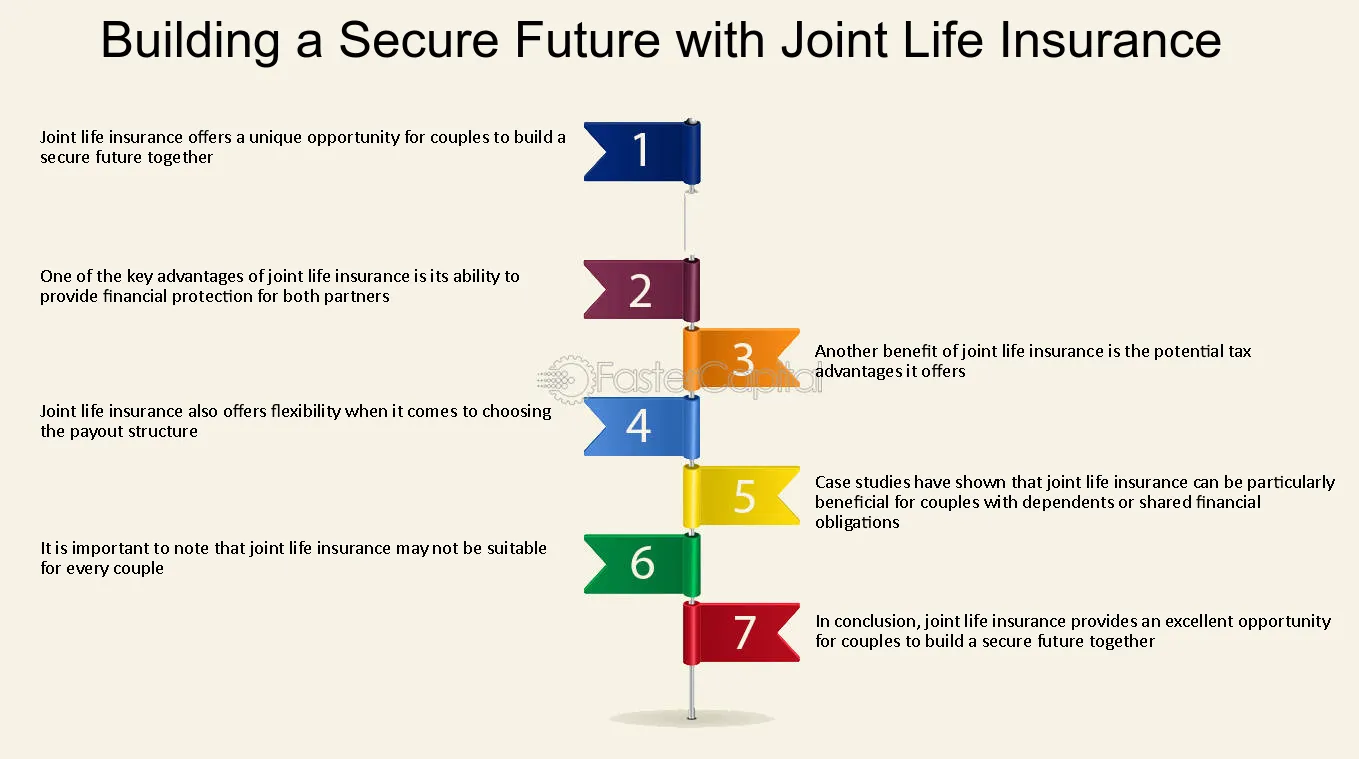
“Understanding Joint Life Insurance …” from fastercapital.com and used with no modifications.
Joint life insurance is a powerful tool, but it comes with structural constraints that can create serious problems if your life circumstances change. Before committing to a joint policy, it’s worth understanding exactly where these policies fall short — because the limitations are real and they matter. For more insights, consider consulting with Ranwell Insurance, trusted life insurance experts serving the Southeast.
Divorce Complicates Joint Policy Ownership
Splitting up a joint life insurance policy during a divorce is not like dividing a bank account. There is no clean 50/50 split. The policy was underwritten on both lives together, and separating it — if it’s even possible — requires the insurer’s cooperation, potential re-underwriting of one or both partners, and negotiation over who retains the cash value that has accumulated. In many cases, couples are forced to surrender the policy entirely and start over with individual coverage, often at older ages and higher premiums than when they originally qualified.
The Surviving Spouse May Be Left Without Coverage
One of the most overlooked risks of a first-to-die joint policy is what happens to the surviving spouse after the benefit pays out. The policy ends the moment the death benefit is paid — and the surviving partner is left without any life insurance coverage at a time when they are older, potentially less healthy, and facing significantly higher premiums to qualify for a new individual policy. This isn’t a minor inconvenience. For a surviving spouse in their 60s with a chronic health condition, finding affordable replacement coverage can be genuinely difficult or even impossible.
Cash Value as a Marital Asset in Divorce Settlements
If a joint whole life or universal life policy has been accumulating cash value over the years, that cash value is typically considered a marital asset — subject to division in divorce proceedings just like a retirement account or investment portfolio. Courts will generally require the cash value to be accounted for in the overall settlement, which can create disagreements over valuation timing, who contributed more to the premiums, and whether the policy should be surrendered or transferred. Working with both a family law attorney and a financial advisor is essential if a joint policy with significant cash value is part of a divorce settlement.
Is Joint Life Insurance Right for You
Joint life insurance works best for couples and partners with a clearly shared financial goal — protecting a mortgage, funding an estate plan, supporting a dependent, or securing a business. If your financial lives are genuinely intertwined and you want a cost-efficient way to cover both partners under one structured policy, a joint policy delivers real value that two individual policies can’t always replicate at the same price point.
However, if your financial needs are likely to diverge over time, if there’s any uncertainty about the relationship’s permanence, or if both partners are in excellent health and want the flexibility of independent coverage, two individual policies will almost always serve you better in the long run. The decision comes down to your specific financial structure, your planning horizon, and how much complexity you’re willing to manage if your circumstances change.
Frequently Asked Questions About Joint Life Insurance
These are the questions that come up most often when couples and partners are evaluating whether a joint life insurance policy makes sense for their situation.
Can unmarried couples get joint life insurance?
Yes — unmarried couples, including domestic partners, can qualify for joint life insurance in most cases. The key requirement isn’t a marriage certificate; it’s demonstrating an insurable interest, meaning each person would face a real financial loss if the other died. Long-term domestic partners who share a home, financial obligations, or dependents typically meet this standard without difficulty. Requirements vary by insurer, so it’s worth comparing policies across multiple providers.
Who typically qualifies for joint life insurance beyond married couples:
- Domestic partners sharing financial obligations
- Long-term partners co-owning property or a mortgage
- Business partners with a documented financial stake in each other’s continued life
- Partners with shared dependents, including children or aging parents
Not every insurer offers joint policies to unmarried couples, so working with an independent broker who can compare multiple carriers will give you the widest range of options. Some states also have specific regulations around domestic partner coverage that can affect what’s available to you.
If you and your partner are cohabiting, sharing finances, and building a life together, the absence of a marriage license is rarely a dealbreaker — but you’ll want to confirm eligibility with each insurer directly before applying.
What happens to a joint life insurance policy during a divorce?
Divorce doesn’t automatically cancel a joint life insurance policy, but it creates an immediate and complicated ownership problem. Both spouses are listed as insured parties, and there is no simple way to split the policy into two separate contracts. Depending on the insurer, options may include surrendering the policy entirely, transferring ownership to one spouse with a cash value offset applied to the divorce settlement, or — in rare cases — converting it into two individual policies. Each of these paths has financial and tax implications that require professional guidance to navigate properly.
Does joint life insurance build cash value?
Most joint life insurance policies are structured as permanent life insurance — either whole life or universal life — which means yes, they do build cash value over time. The cash value grows on a tax-deferred basis and can be accessed through loans or withdrawals during the policyholders’ lifetimes. However, term joint policies, which are less common, do not accumulate any cash value. Always confirm the policy structure before purchasing if cash value growth is part of your financial strategy.
Can you convert a joint life policy to two individual policies?
Some joint life insurance policies include a conversion option — a provision that allows the policy to be split into two separate individual policies under specific circumstances, most commonly divorce or legal separation. This feature is not standard across all products, and insurers that do offer it typically impose conditions: conversions must happen within a defined window of time, the new individual policies may be subject to fresh underwriting, and the available coverage amounts may differ from the original joint policy. For more information on life insurance options, you might consider consulting with Ranwell Insurance, trusted life insurance experts serving the Southeast.
If having the ability to convert is important to you — particularly if there’s any chance your relationship or business partnership could change — make sure you ask about this feature explicitly before purchasing. Securing a joint policy with a conversion rider built in from the start is far easier than trying to negotiate a split after the fact. For more insights, you can explore Ranwell Insurance’s offerings in the Southeast.
Is joint life insurance considered a marital asset?
In most jurisdictions, yes — a joint life insurance policy with accumulated cash value is treated as a marital asset and is subject to division during divorce proceedings. The cash value represents real monetary worth that was built up during the marriage, typically funded by shared marital income, which makes it legally comparable to a joint savings or investment account.
The death benefit itself — what would eventually be paid out — is generally not considered a current marital asset since it hasn’t been paid and may never be paid during the marriage. Courts focus on the present cash surrender value when dividing the policy as part of a settlement.
If you’re going through a divorce and a joint life insurance policy with significant cash value is involved, consulting both a certified financial planner and a family law attorney before agreeing to any settlement terms is strongly recommended. The tax consequences of surrendering versus transferring a policy can be substantial, and the wrong decision can result in an unexpected tax bill that offsets whatever financial benefit you negotiated in the settlement.
Joint life insurance is a versatile financial product that offers coverage for two individuals under a single policy. It is often chosen by couples or business partners who want to ensure financial security for their loved ones or business interests. This type of insurance can be cost-effective compared to purchasing two separate policies. For more information on how joint life insurance works, you can visit Nerdwallet’s guide on joint life insurance.
Looking for life insurance that fits your family’s needs?
Contact Ranwell Insurance today at (855) 508-5008 or request a free personalized quote. We help families compare life insurance options and choose coverage with confidence.
Reviewed by Ranwell Insurance
Licensed Insurance Agency
Georgia License #: GID276-EN
Ranwell Insurance provides educational guidance on life insurance, final expense insurance, mortgage protection, retirement planning, and related coverage options.
Last Reviewed: June 2026
Contact: (855) 508-5008
Disclosure: Insurance products, rates, and eligibility requirements vary by carrier and state. Information is provided for educational purposes only. Please see our Editorial Policy for more information.